

Welcome to the inaugural issue of Compounding Weekly!
I’ve been fascinated by investing and the stock market for as long as I can remember. What began as an interest in buying and selling stocks gradually developed into a much deeper appreciation for the businesses behind them.
For over 8 years now, I’ve shared my investment thoughts, portfolio commentary, and longer-form analysis at The GARP Investor. That project isn’t going anywhere. I intend to continue publishing my more detailed investment research there.
But those quarterly updates take considerable time to research and write, and I’ve wanted an outlet to share shorter observations on a more regular basis.
That’s where Compounding Weekly comes in.
Each Friday, I’ll share my weekly thoughts on the markets, discuss businesses that catch my attention, and explore investing concepts I find particularly interesting. Sometimes that might mean examining an earnings report, while other times it could be an unusual business model or a broader investing lesson.
My philosophy is straightforward. I believe long-term investment returns are driven by the quality of the businesses we own, the prices we pay, and our willingness to let compounding work over time.
Rather than predicting where the market is headed next, I hope this newsletter will be an opportunity to think critically about investing, share what I’m learning, and hopefully become a better investor along the way.
Thanks for reading.
Quick Thoughts
Market Volatility: Well, I certainly picked an interesting time to launch an investing newsletter. Technology stocks have experienced a brutal stretch, with the Nasdaq plunging 5.5% on November 5 before staging a partial recovery. The volatility is a reminder that even exceptional businesses can be poor investments when expectations become unreasonable or difficult to predict. I remain optimistic about the long-term prospects of many of these companies, but valuation matters. A wonderful business and a wonderful investment are not necessarily the same thing.
Nvidia’s Leadership Crisis: In one of the most extraordinary developments of the year, Jensen Huang has resigned as CEO of Nvidia, the company he co-founded and transformed into the dominant force in AI computing. CFO Colette Kress has been appointed interim CEO. There are few executives more closely associated with their company’s success. While Nvidia possesses extraordinary technological advantages, losing its visionary leader introduces genuine uncertainty. It’s a striking example of key-person risk, even at one of the world’s largest and most successful businesses. Personally, I’d much rather have Huang running Nvidia than an unproven successor.
The AI Spending Boom: Meanwhile, the technology giants continue committing staggering amounts of capital to AI infrastructure. According to recent reporting on the AI investment boom, companies like Alphabet, Microsoft, Amazon, and Meta are collectively spending hundreds of billions of dollars on data centers and computing capacity. The opportunity is enormous, but so are the financial commitments. The critical question isn’t whether AI will transform the economy; it’s whether these investments will ultimately earn attractive returns.
Idea of the Week: The Cash Citadel
I’m introducing a concept I call the Cash Citadel.
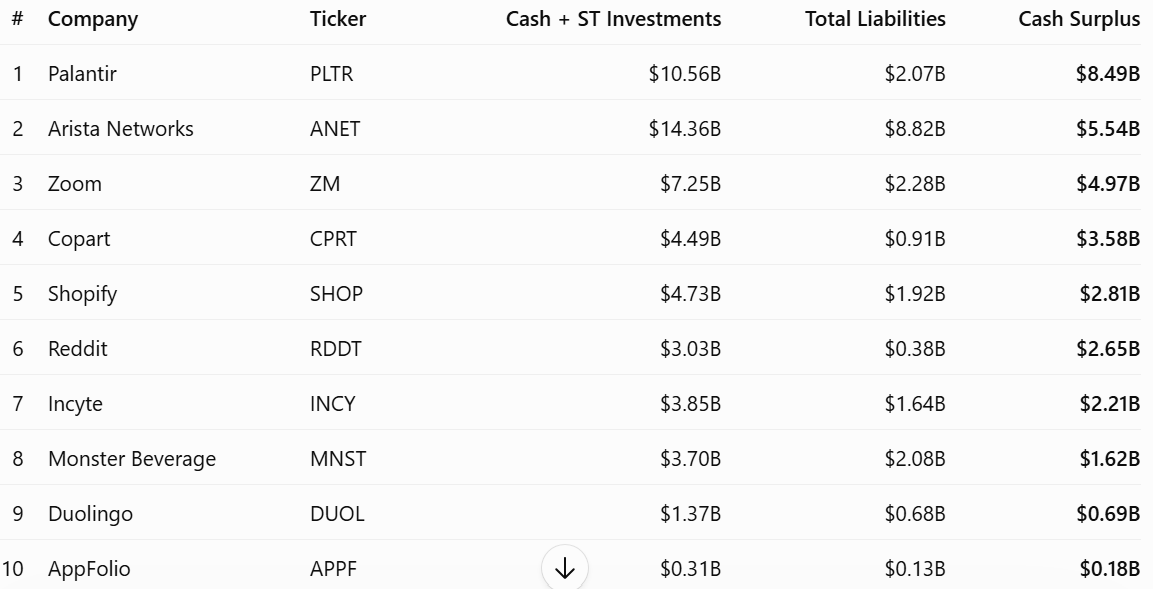
The definition is simple: a company whose cash, cash equivalents, and short-term investments exceed its total liabilities.
These companies possess such extraordinary financial strength that even a catastrophic collapse in revenue might not threaten their survival.
While a strong balance sheet doesn't necessarily indicate a great business, it's often the result of years of exceptional profitability, disciplined capital allocation, and attractive underlying economics.
Consider Veeva Systems, the software company serving the life sciences industry.
According to its fiscal 2027 second-quarter financial results, Veeva holds approximately $7.24 billion in cash and short-term investments against just $1.63 billion in total liabilities.
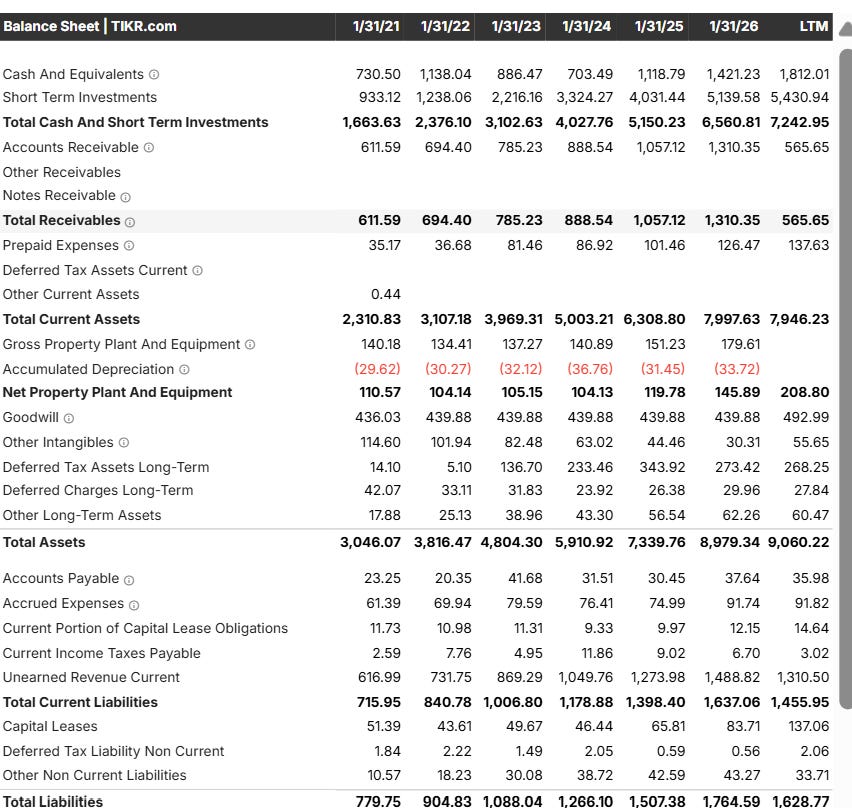
Even more remarkable, its annual cost of goods sold and operating expenses total approximately $2.42 billion.
Imagine that Veeva generated absolutely zero revenue starting tomorrow. Not a single dollar.
At its current expense levels, Veeva holds enough cash and short-term investments to theoretically cover roughly three years of expenses at today’s reported run rate, even if revenue fell to zero. This is an intentionally extreme hypothetical, not a precise cash-flow projection, but it illustrates the extraordinary financial protection Veeva possesses.
And in reality, management would almost certainly reduce expenses long before reaching that point.
But the significance extends beyond simply surviving a recession.
A Cash Citadel gives management the freedom to think offensively when competitors are forced to think defensively.
These companies can continue investing, pursue acquisitions, and endure periods of economic turmoil without relying on lenders or capital markets.
A strong balance sheet won’t guarantee investment success. But it provides something extraordinarily valuable: the ability to survive when almost everything goes wrong.
And in investing, sometimes survival is the most important competitive advantage of all.
The Weekly Wildcard
To wrap up each issue, I want to have a little fun. This section will change from week to week. Sometimes it might be a Top 10 list, a Mount Rushmore of a particular industry, a This or That debate, or something entirely different. The goal is simple: explore interesting ideas about business, investing, and the economy without taking ourselves too seriously.
For our inaugural issue, let’s stick with the Cash Citadel theme and look at 10 other companies with exceptionally strong balance sheets that fit the criteria.
Thanks for reading the inaugural issue of Compounding Weekly. See you next Friday!